
Article: Guidelines and standards for the study of death and recalled experiences of death––a multidisciplinary consensus statement and proposed future directions.
Author(s): Sam Parina
Journal: Annals of the New York Academy of Sciences
Download as PDF
The authors of this paper propose a set of definitions and terminology to adopt when studying near-death experiences which they suggest be re-defined as RED (recalled experience of death).
RED is defined as:
a specific cognitive and emotional experience that occurs during a period of LOC [loss of consciousness] in relation to a life-threatening event, includ-ingcardiac arrest. The issue of LOC relates to assessments from the perspective of a clinician or other external observer, even though from the perspective of the person experiencing a RED, often there was no perception of any LOC. In fact, many report a heightened sense of consciousness. It includes mul-tiple specific themes
The identified themes (and sub-themes that may or may not all be experienced) related to RED include;
Separating from the body. A realisation of having died. Visual awareness, usually observing the body or events from above and having a 360 degree vision.
Heading to a destination. Being drawn towards a destination or traveling through a tunnel.
Life review. Review of every moment of life including all thoughts, intentions and actions. Includes experiencing from perspective of others.
Being home: feelings of returning to a place that was known before. An atmosphere permeated by benevolence, kindness, knowledge and truth. Experience being more real than real.
The return: Reaching a point of no return and then turning back.
Reported effects after the experience: Ineffability, challenge to personal interpretation of purpose and meaning in life. Loss of fear of death. Long-term positive efffects.
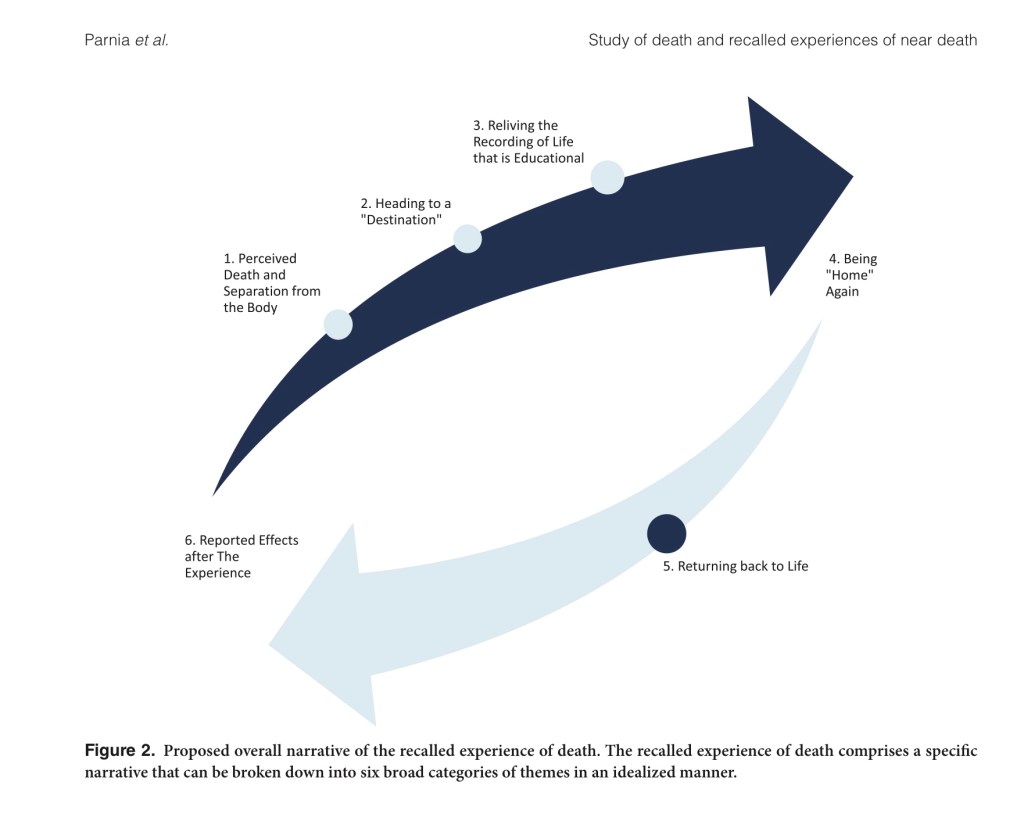
The 6 components of RED.
- a relation with death.
- a sense of transcendence
- ineffability.
- positive transformative effects (related to meaning and purpose to life)
- severity of illness and that leads to a loss of consciousness (LOC).
- absence of features of other coma-related experiences (such as dreams, delerium and delusions).

 deathPoints.com
Leave a comment