

There are now over 2,000 reported cases of children expressing past life memories that have been collected over the last 50 years. This is a summary of a paper published by Masayuki Ohkado in the journal ‘Explore’.
This case details the claims of Takeharu a Japanese boy living in Hiroshima.
Despite being rised in a Shinto family (which has no belief in reincarnation) and growing up in a family with no interest in military affairs, from the age of 2, Takeharu began to express memories of serving on the Japanese Navy battleship Yamoto during world war 2.
Takeharu’s pronouncements came as a complete surprise to his parents. His mother began keeping a diary to record his behaviours before finally contacting the author of this paper in 2020.
Some of the more interesting events that she recorded included:
- Age 2. Insisted on playing battleships in the bath with his brother and regularly said “I wont die”
- Age 3. Drew the picture below which the paretns later interpreted as the Yamato being attacked by US airplanes.
- Began to repeat: “I want to see the Yamato” remarks that initially made no sense to the parents.
- Age 4. Displayed a phobia of water and refused to play in a swimming pool.
- Repeatedly made the following statemets: “Thre was a very strong battleship”
“They got us on the left side”
“It exploded”
“We went to get help, but they got us and I died”.
“I drowned”. - Age 5. Said: “I was on the invincible battleship Yamato. But on the way to Okinawa, we were attacked and killed. The left side of the ship was attacked over and over again. Inside the ship, I calculated using an abacus.”
- Age 7: “Americans were not fair. They kept on attacking the same side. Torpedoes hit the left (port) side and the Yamato listed. They put water from the right (starboard) side, but it was no use. Because of the heavy bombings, people got injured and the deck was red with blood. We couldn’t fire because it was cloudy and couldn’t see Americans. Phreatic eruptions occurred. It was scary. It hurt. Nobody helped me. I called mom. Because of the whirlpools, I couldn’t swim and sunk with the battleship.”
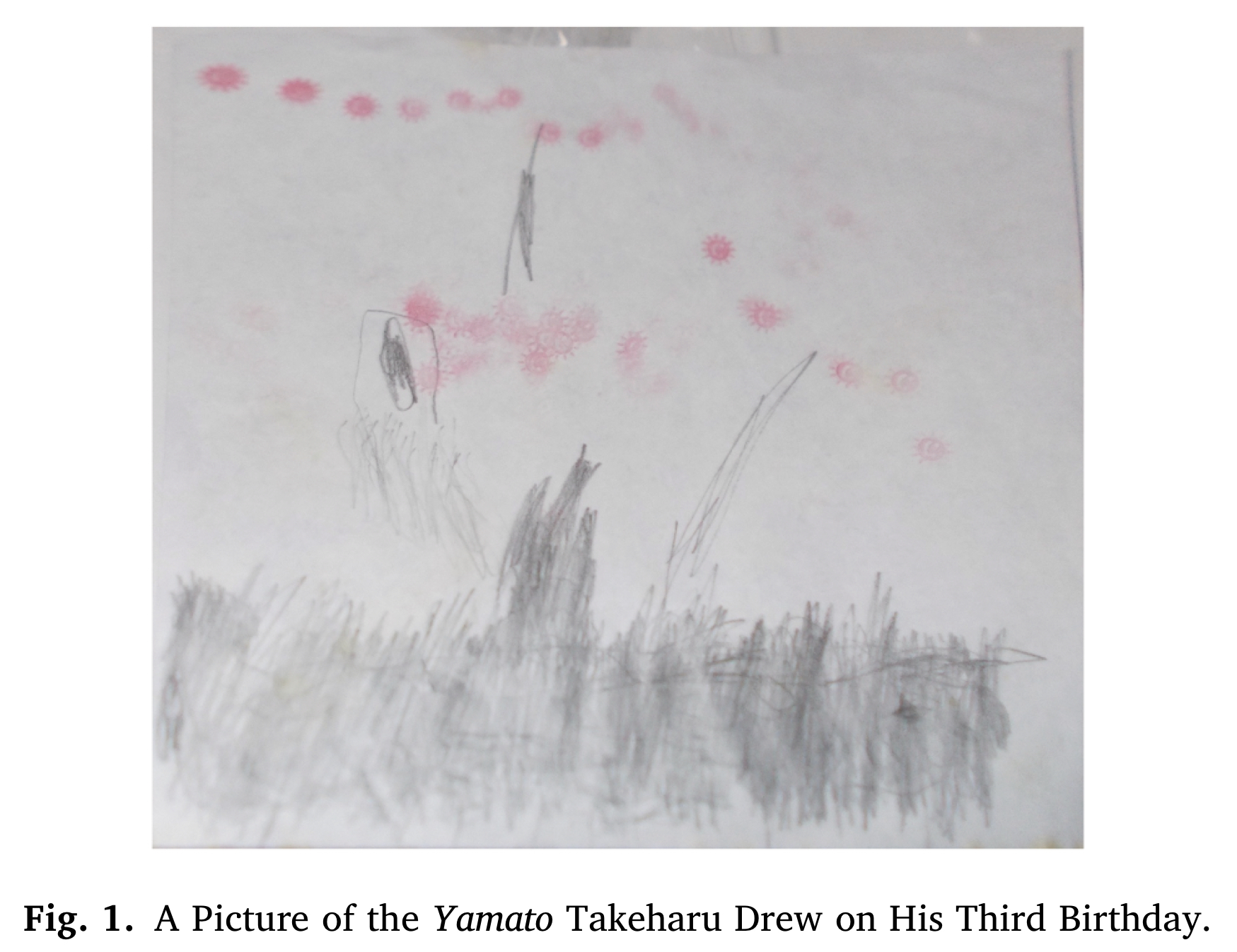
Takeharu had not had access to any information regarding the Yamato until his parents took him to the Yamato Museum at the age of 4 years and 11 months.
Takeharu was 8 years old by the time the author interviewed him. His memories of the Yamato were fading. He stated that he was in charge of guns (but not the main ones).
A few of the statements he made during the interview included:
- “I loved to drink sake, and I remember I drank a lot at the farewell party on the night before the final battle.”
- “Before the battle, rice balls were served, and I ate them quickly.”
- “During the battle, I don’t remember why, but I got hurt.”
- “During the battle, the deck was filled with blood and the bodies of crew members.”
- “My memory is fading, and before it is gone, I want to meet my (former) mother. If I can, I want to tell her: Don’t worry, I’m doing fine.”
After much research, the author of this paper was able to identify potential individuals who matched Takeharu’s stories.
Takeharu was shown a series of photos of 5 crew members of the Yamato and three crew members from 2 other Japanese ships involved in the battle.
He identified one of the individuals as being his prior self.
Unfortunately, there was little information available on the identity of this person apart from that he was responsible for the Yamato’s secondary armament, and it’s transmitting station at the time it was sunk.
The author concluded:
The case of Takeharu appears to be another example which is unlikely to be accounted for by normal means such as fraud, fantasy, and knowledge acquired through normal means. Takeharu’s unusual knowledge, behaviors, and emotional traits were limited to the particular person, and he showed no psychic abilities. Although the identification of the past-life personality is not conclusive, the present case has an advantage that the investigation was not started by any of the family members. Therefore, possible contamination of the data as suggested by Sudduth15 in the case of James Leininger is unlikely to be involved. I hope this paper has presented another strong case which is most likely to be accounted for by the notion of reincarnation. Takeharu, although sad that he was unable to meet his past-life family members, especially, the mother, he said he was satisfied to have been able to identify who he had been.
Paper: A Japanese case of the reincarnation type with written records made before verifications: A child claiming to have fought on the battleship Yamato
Author(s): Masayuki Ohkado
Journal: Explore
Date published: July 2022
Link to summary.

 deathPoints.com
Leave a comment