

What would it take to convince sceptical academics that consciousness survives death?
A group of researchers from the Institute of Noetic Sciences wanted to find out. So, they surveyed a group of 442 academics including scientists, engineers, and other professional fields.
Just what sort of experimental proof would convince a skeptic to reassess their prior beliefs?
The researchers designed a set of 10 (thought)experiments that might test the survival of consciousness after bodily death, and then asked the participants if a positive result would change their existing opinions.
The goal was to design prospective experiments that, if they had not been conducted already, could potentially be conducted in the future and might provide robust evidence.
- The Apparition in the Lab. Using a medium to invite a deceased person to influence a controlled source of steam.
- Deceased communicating through AI.
Using a medium to invite a deceased person to influence an AI chatbot to generate verifiable information about the deceased. - Glossolaia/Xenoglossy. Using channellers to speak in a foreign language that is verifiable as being unknown to them.
- Channeling Specialised Expertise.
Channeller able to communicate with a deceased person and can display highly specialised skills (such as maths, chess playing, musicianship etc) that they do not possess. - Mediumship. A group of hospice residence are recruited and agree to contact a second group of mediums within 30 days after they pass away.
- Reincarnation experiment.
A dying person provides a selection of personal objects that are placed in a sealed container without anyone else knowing the contents. A person claiming to be the reincarnated person would then be able to accurately describe the contents of the box. - After Death Communication experiment.
People who claimed after-death synchronicities would be recruited to wear body cameras and indicate when they experienced synchronicities. The data would be evaluated by a panel of judges. - Physical Mediumship in a Daylight Setting.
Physical mediumship studies conducted in full daylight and a highly controlled environment. - Out-of-body experiences during NDE.
Veridical, accurate reporting by the person who experienced a NDE of random images on a computer screen placed in a high, unobservable (to hospital staff and patients ect) position. - Survival Through Artificial Intelligence.
An AI that can produce memories and personality traits of a deceased person that are not otherwise known.
Link to original study: Rating the Persuasiveness of Empirical Evidence for the Survival of Consciousness After Bodily Death
Results:
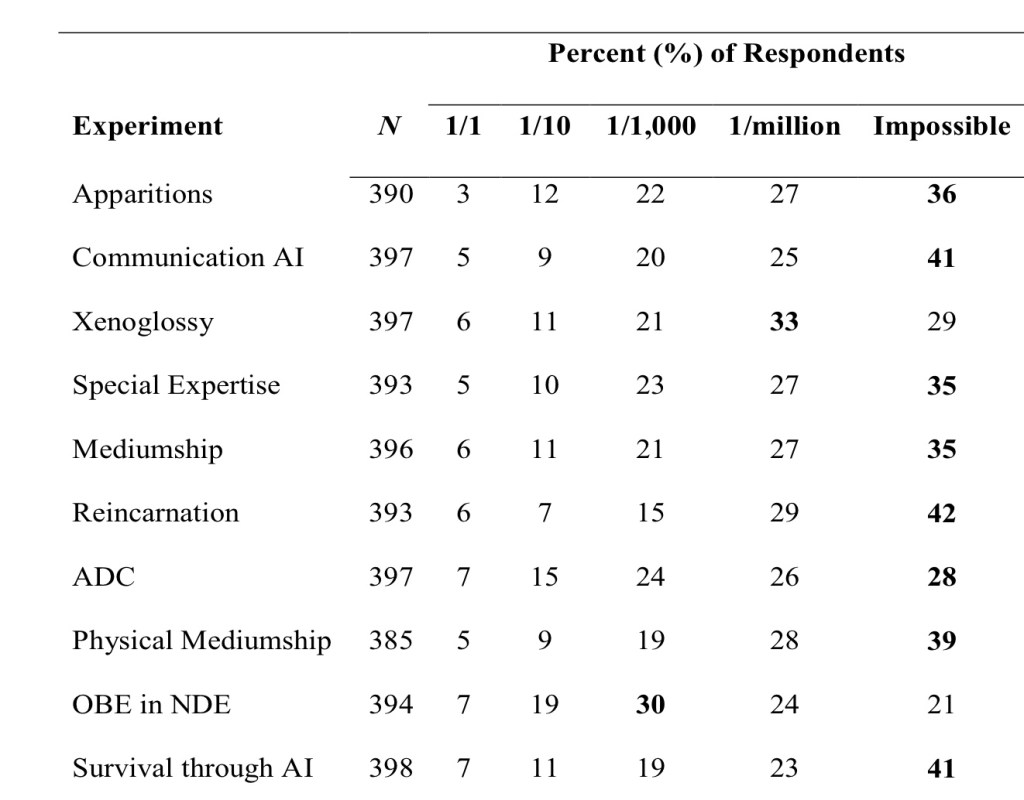
In general, most did not think that the proposed experiments would be completed with positive outcomes. The proposed experiments were chosen based on the existing evidence for the survival of consciousness. Overall, the experiments were selected as plausible, and we did not exclude experiments that may be challenging to undertake given current technologies. This choice may partly explain the low likelihood ratings. Thus, these results are not completely unexpected, given that the prospective systematic study of the nature of consciousness is still a growing field.
Conclusion:
The current study suggests that scientific evidence (at least as provided by the proposed experiments) would not be strong enough to persuade academics that currently do not believe in the survival of consciousness or psychic phenomena. For those that already believe or are uncertain, prospective studies involving an OBE in NDE, mediumship, and reincarnation may be persuasive. The prospective, systematic study of consciousness is still growing. This subtype of research has largely remained outside the mainstream as a scientific and scholarly discipline, a state of affairs that appears to be slowly changing. The question of survival lies at the heart of our most basic existential questions and warrants continued research.

 deathPoints.com
Leave a comment